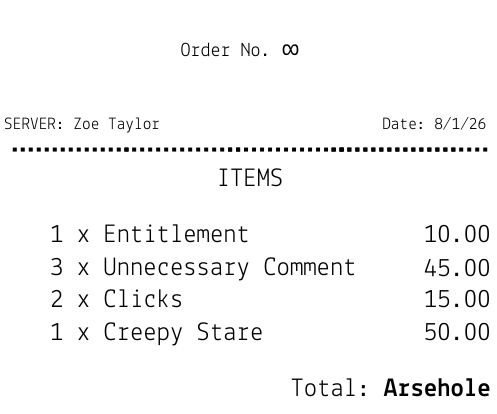
Working in hospitality is not for the weak. As a mixed-race woman, service sometimes comes with an extra helping of harassment.
It is a truth universally known that customer service jobs are the worst. Minimum wage pay, long hours on your feet and entitled customers make it tiring both mentally and physically.
There is a power dynamic between the server and diner – it’s in the name, I suppose. The diner has the power and the server is at their beck and call. Mix in the existing social hierarchies and the imbalance impacts women even more. Often, it’s not only guests who can make you feel uncomfortable, it’s co-workers too.
A 2025 poll by Unite The Union found that 56% of women have been the recipient of sexual jokes and 55% had experienced unwanted flirting at work. The food and drink industries were among those with the highest rates of harassment. This is despite the 2023 Worker Protection Act which requires employers to ‘take reasonable steps’ to stop sexual harassment.
In the hospitality space, men have often felt entitled to tell me about how I should look. I’ve been told my piercings are ugly or that it’d be nicer if I didn’t have so many tattoos. In what world has a man ever been told something like that?
The other interaction I get to have with customers is about my race. The age old: “Where are you from?”… “I’m from here”…. “Noooo, where are you really from?”
I know this isn’t usually asked with bad intentions but it always irks me, it’s not really your business where I’m from. For people to never be satisfied with my answer implies that they are assuming that I can’t be British because I don’t look the part. It highlights the preconceived notion that people of colour don’t belong. Last year, racially motivated hate crimes rose for the first time in three years, another reason to dodge the question.
When I was younger, working in restaurants gave me a lot of anxiety. Once, the chefs made a list of the waitresses, rating them by their asses. When I didn’t laugh, they said: “ooh you must be some sort of feminist then” which was apparently hilarious. Interactions like this have shaped my worldview and beliefs. Telling a woman to put more effort into her looks to get tips when everything is split between staff is rude and selfish. People asking if me and another Asian co-worker are siblings is weird. Sometimes I feel a bit like a display item that men just want to look at or a character being fetishised by guys who ‘love Asian culture’.
It feels like women are less respected as servers than men because the worker is in a subservient position which removes their power. This is something that has already been done to women so to disrespect a waitress feels normal. That’s why jokes like ‘get back in the kitchen’ aren’t funny. Because when you go back there all the chefs are men.
Along with this is the subtle racism which permeates British culture. Comments like ‘you look exotic’ or ‘have really good English’ which are meant as compliments, don’t feel that way. The dangerous, and hurtful, idea that I am not English despite being born and raised here because one of my parents was born elsewhere – which just under half of respondents to a 2017 YouGov poll believed.
I know I’m not the only one who’s experienced this sort of harassment. My friends and I have lamented how much we hate our jobs and the awful people we have to deal with. It’s not just women either, I know men have been harassed by female customers or talk about something that happened to them in jest that sounds weird but they are unbothered by it. I suppose it’s great that they can laugh things like this off. That it can be a funny, weird thing that happened to them because for a lot of women, it’s scary.
The service industry is in many ways a good reflection of how society functions. Despite the progress which has been made, the undercurrents of misogyny and racism flow beneath the surface. As of 2023, 85% of the hospitality workforce were white, only slightly higher than the national rate in the same year. In the same vein, a 2021 study found that men were more likely to be in management positions, despite more women working in the industry.
I still work as a waitress. As a uni student, it’s hard to do much else, and I do enjoy it. As the years have gone on, my workplaces have gotten better and I have become better at shutting down bad behaviour. As for the wider world, the conversation about harassment and inappropriate behaviour is much louder than before and more women and people of colour are sharing stories and holding people to account. Threats from the far-right and ‘anti-woke’ agenda do loom, but everyday people are still kind and respectful.
Let’s just hope that continues.