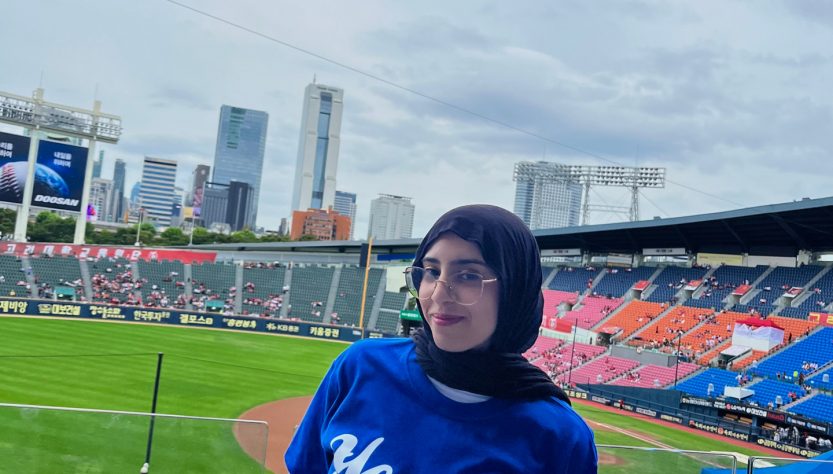
When Ameera Saad, a third-year Journalism student at Kingston University, ended up in the emergency room of a hospital in Seoul, far away from her family and friends, reality struck: her year abroad would not only be an academic adventure, but also a strong test of resilience.
Ameera’s dream has always been to travel to Korea, and with the help of the university, she is now living there for a year. But while this sounds amazing, Ameera has had her fair share of tests since arriving.
Ameera worked hard to ensure her severe allergies to nuts, fruits and vegetables would be accommodated. But since landing in Korea in September, she has already developed two new allergies – grapes and carrots.
“I ended up buying noodles from a restaurant which had carrots, which didn’t bother me at the time, until I ended up having an allergic reaction to them,” Ameera explains. “I called the emergency services for an ambulance, and my friend came with me as she was able to translate”.
This incident has meant that she now battles daily anxiety when buying any food and drink. “Sometimes I buy something and I’m scared to drink it,” she admits. Recently, I ordered a cup of black tea, it came with some rosemary herb, and I’m not allowed rosemary. I ended up throwing it away”.
It may be an extreme example, but Ameera’s overseas experience shines a light on what can really happen when you take your studies overseas.

Students opting to take a study-abroad programme still isn’t the norm for most UK undergraduates. According to Universities UK, only around 6-7% of British university students decide to take part. However, there is a growing appetite for overseas adventure: recent statistics from Universities UK show that over 650,000 students are now studying UK programmes abroad – a 70% increase in the last decade.
Ameera always knew that she wanted to study in a different country, but when it came to studying abroad, initially she “didn’t know much” about the programmes. She found the application process “really long and really tiresome”, which impacted her second-year studies. “It took more time because I also had to write about myself, write why I would be a good choice.”
There were other factors Ameera needed to consider; as well as having a place to pray in peace as a hijab-wearing Muslim, her allergies meant she needed to have her own fridge, her own room.
Luckily, the university was very helpful with getting her medical notes approved and signed. “The disability team at Kingston did really help me, and it was a really quick and simple process,” she said. “I felt like the pressure was really getting to me, but I still managed to get everything done. It worked out in the end, and I’m really glad it did but it was very stressful time for me.”
While Ameera did have that moment in peril while studying abroad, she has enjoyed the experience on the whole.
“It’s been really fun,” she says. “My schedule is much more packed with reading. “I take a lot of exams, and we do a lot of presentations, and group work, whereas in Kingston there’s less group work and more independent studies. But honestly, it’s been really fun.”
