
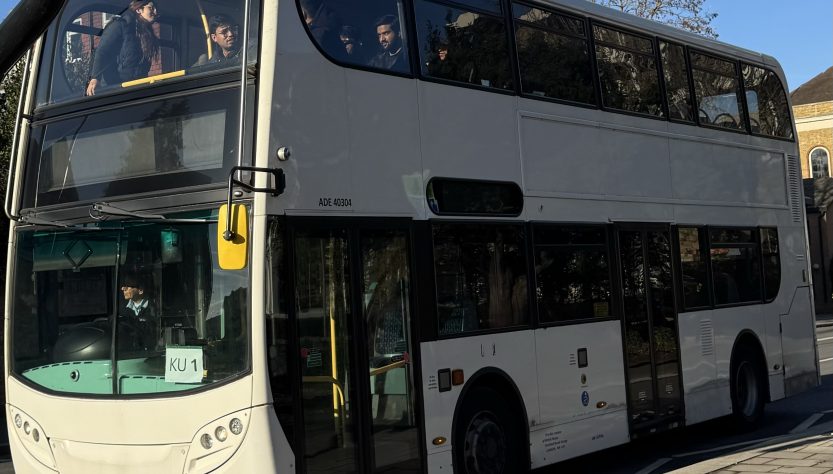
Residents of Seething Wells were left abandoned by the KU1, what once was a reliable twenty-minute wait was now an hour-long delay, leaving many finding it particularly irritating.
The shuttle bus system at Kingston University is designed to make it easy for students to travel around, but the service that took students from their halls of residence to campuses, and even the town centre, was now the most stressful part of the day for students living in Seething Wells.
The KU1 service, which connects Seething Wells to Penrhyn Road, has become a major concern with long delays, unpredictable timings, and poor tracking, leaving students regularly stuck, while most students travel without issue on the KU2 and KU3 routes.
Being one of the biggest halls at the university, Seething’s was only accessible via the KU1, so the bus is crucial for many international and first-year students who live there. However, wait times of 40 to 70 minutes had been more common in this term.
A Kingston University spokesperson said delays had been affected by “ongoing congestion and roadworks across the borough,” which they said had impacted journey times and schedules. They added that live tracking and updates “are available through the KU app,” though many students say the tracker is unreliable.
International student Heo Seowon, who relies on the bus almost daily, said: “I live in Seething Wells, and it is so bad. I have to walk instead because sometimes it takes more than one hour to come, and I am just not waiting for that. There are so many people standing outside the stop, and that’s how I know that there is no point in waiting. Luckily, I like walking, but in the cold, it is not that fun.”
Her flatmate at Seething’s, Gabi Chou, has had her own horrible experiences with the service. “I had a dance class from 5 to 6 pm, and I wanted to take the usual KU1 bus back to Accom,” she said. “But I forgot how useless it is. I was just standing there at night in the cold, begging for the bus to come because I was too exhausted to walk.” She said she kept checking the live tracker on the Kingston Uni app, “and there were no changes at all, then 50 minutes later it finally showed up.”
Both Seowon and Chou described the Kingston Uni app as “unreliable,” “confusing,” and “completely pointless” for tracking KU1, which highlights another significant problem. Often, the live tracker freezes and displays timings that differ from the schedule given, or it shows buses that weren’t operating. This made it increasingly difficult for students to plan their days to and from campus, and even nights out.
Meanwhile, students living in other halls experience none of these problems. Clayhill resident Jeff Huang says: “I take the KU2 and I’ve never had any issues with the KU bus, it’s always on time,” highlighting that the delays are not university-wide, but specific to the KU1 route.
With 886 students impacted, the KU1 delays caused concerns about scheduling, capacity, and whether Kingston’s largest residence hall can be properly run by a single bus route. The spokesperson said the university’s bus service is “under continuous review” as part of its Travel Plan and confirmed that major changes are coming in 2026. They said a new “all-electric bus fleet” will launch in summer 2026, delivering zero-emission travel and “significantly reducing air pollution.”
They also confirmed that “service improvements are planned for the KU1 route,” including additional buses during morning and late afternoon to reduce wait times “from every 35 minutes to every 20 minutes at peak times.” Student feedback, they added, has helped shape these plans through initiatives such as the KU Travel Survey.
For the time being, the KU2 and KU3 are currently operating without any issues but Seething Wells students are still waiting often for a solid means of transportation.
